What TTP Town actually is
Tuol Tom Poung is a neighbourhood in the south of Phnom Penh, anchored by Psar Tuol Tom Poung — the market that gives it its name and most of its character. It sits between the polished expat bubble of BKK1 to the northeast and the more chaotic local districts further out. That position is not accidental. It's what the neighbourhood is.
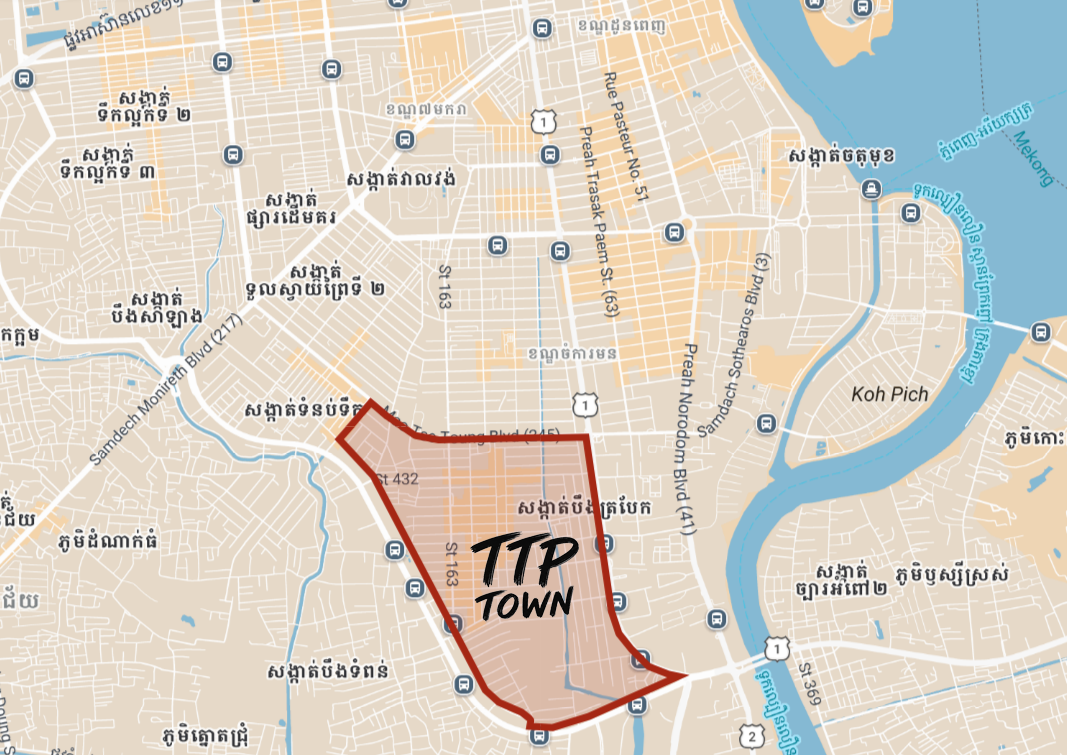
Most of Phnom Penh's neighbourhoods are legible: BKK1 is for people with money and no interest in Cambodia, Daun Penh is historical, Toul Kork is functional and great for families. TTP Town is harder to place — and that's exactly why it works. It hasn't been designed for any particular group. Khmer families, NGO workers, freelancers, and long-term expats all ended up here for different reasons and stayed for the same one: it's the most liveable square kilometre in the city.
Who lives here
The mix is the point. TTP Town's population is a layered thing — Khmer families who have been here for generations, NGO workers on two-year postings, freelancers who came for a month and stayed for three years, teachers, translators, photographers, and the occasional person who genuinely cannot explain how they ended up here.
What they share is a preference for a neighbourhood that functions. Good internet. Affordable rent. A wet market within walking distance and a wine list two streets over. There's a decent café and a good noodle stall on the same block. Nobody planned it this way.
The community is informal in the best sense — not organised, not curated, not particularly visible. It exists in quiz nights, karaoke nights, food pop-ups, and the fact that the same people always keep appearing at the same places.
The feel of the place
TTP Town is still rather low-rise, walkable, and loud in the right ways. The streets smell like charcoal grills in the morning and fried noodles in the evening. There are tuk-tuks, motorbikes, construction, and at least one dog that everyone knows by name.
The market is the anchor — not just as a place to shop, but as an orientation point. Everything in TTP Town is near the market or near something that's near the market. It's the kind of urban layout that happened organically, which means it doesn't make sense on a map but makes complete sense when you're walking it.
The neighbourhood is not polished. That's not a complaint. Some streets still flood in rainy season, some landlords are still unreliable, and the traffic on the main roads is a genuine problem. But the tradeoff — a functioning, affordable, genuinely mixed neighbourhood in a capital city — is one most people here have consciously made.
TTP Town vs BKK1
BKK1 is where Phnom Penh smooths its edges. TTP Town is where you live if you want it to feel like Phnom Penh. That's not a value judgement — both are legitimate choices. But they are genuinely different places with genuinely different residents.
BKK1 has better infrastructure, higher prices, and a social scene that largely replicates what its residents left behind. TTP Town has cheaper rent, way more interesting food, and a social scene that has nothing to prove. The overlap is smaller than you'd think.
People move from BKK1 to TTP Town regularly. The reverse is rarer.
A neighbourhood changing
TTP Town is mid-transition. After years of rising prices, the rental market has softened. A wave of newly completed condos has added supply faster than demand, pushing landlords into negotiation for the first time in years.
The change is visible on the streets. New buildings continue to replace older shophouses, but the upward pressure on rent has eased. Apartments that sat empty at peak pricing are now quietly discounted. The balance has shifted — slightly — towards tenants.
The neighbourhood hasn’t lost its character — but the timeline is still visible. The shophouse your favourite café is in: someone still wants to build condos on it. The landlord knows. But for now, the market is catching its breath.
This site documents the neighbourhood as it is now — including the parts that are changing direction. If something closes, we say so. If something shifts, we update it. This isn't an archive. It's a running record.
Why people stay
Ask someone who's lived in TTP Town for more than a year why they haven't moved and they'll usually pause before answering. Not because they don't know, but because the reasons are hard to separate from each other.
It's the price. It's the food. It's the fact that the market is always five minutes away, on foot, and a decent bottle of wine is ten. It's the specific combination of being in a capital city — with everything that implies — while paying rent that makes the capital city sustainable.
Mostly it's that the neighbourhood doesn't ask anything of you. It doesn't require you to perform a lifestyle or subscribe to a scene. You can be here quietly, or loudly, and the street doesn't care either way.